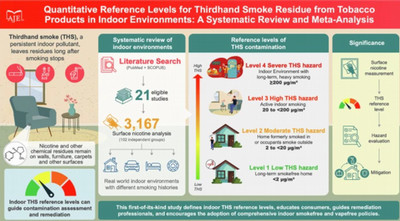
A new study published in the Journal of Exposure Science and Environmental Epidemiology (JESEE) marks an important milestone in public health by establishing the first-ever quantitative reference levels for thirdhand smoke contamination. The study provides a scientific framework for identifying, measuring, and addressing the toxic chemical residue left behind by tobacco products that are used indoors.
Key Findings and Impact
- First Benchmarks: The study defines four distinct Reference Levels (RLs) based on nicotine surface concentrations, ranging from Level 1 (Low Hazard: <2 μg/m2) to Level 4 (Severe Hazard: ≥200 μg/m2).
- International Scope: Researchers synthesized data from 21 studies in the U.S., China, and the U.K., comprising over 3,000 measurements from 102 independent environments.
- Informing Legislation: The findings arrive as California prepares for a landmark law (AB 455) requiring THS disclosure in residential real estate transactions, setting a precedent for national and international policy.
- Protecting Vulnerable Populations: The study highlights that thirdhand smoke residue contains 26+ toxic compounds (including nicotine, lead, cadmium, and arsenic) and poses the highest risk to young children and individuals with compromised health.
“Thirdhand smoke residue is a persistent toxic indoor pollutant that can persist for years after smoking has stopped," said Georg E. Matt, Ph.D., lead author and Professor of Psychology at San Diego State University. "Until now, we lacked a common yardstick to assess the severity of this contamination. These reference levels change that, offering a practical tool for homeowners, property managers, remediation professionals, and policymakers to make informed decisions about the safety of their indoor environments."
The research emphasizes that thirdhand smoke is not merely an odor problem but a chemical hazard. The residue penetrates deeply into building materials, furnishings, carpets, and upholstery, making traditional cleaning methods and even painting largely ineffective. The established levels reveal a clear pattern of increasing hazard: from long-term nonsmoking homes with strict bans to environments with heavy long-term smoking, such as casinos and homes where occupants regularly smoked for years.
"This study is an environmental justice call to action," the research team added. "Higher THS levels are often found in older, poorly maintained housing where smoking was previously permitted, disproportionately affecting low-income and marginalized communities. Establishing these benchmarks is a critical step toward reducing exposure among the most vulnerable individuals."
Article
“Quantitative Reference Levels for Thirdhand Smoke Residue from Tobacco Products in Indoor Environments: A Systematic Review and Meta-Analysis” Journal of Exposure Science and Environmental Epidemiology https://doi.org/10.1038/s41370-026-00916-0
Media Contact
Georg E. Matt, Ph.D.
Director, Center for Tobacco and the Environment
San Diego State University
Email: gmatt@sdsu.edu
Website: thirdhandsmoke.org
Watch the video summary “Practical benchmarks for safety from thirdhand tobacco smoke residue”