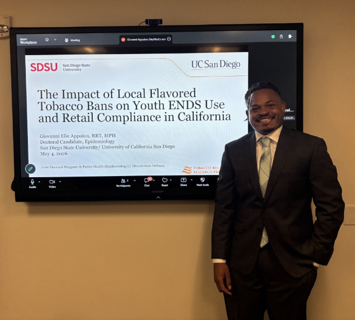
TRDRP Trainee Spotlight: Dr. Giovanni Elie Appolon
Giovanni Elie Appolon, RRT, MPH, PhD | Postdoctoral Fellow
University of California, San Francisco's Center for Tobacco Control Research and Education
“You never know unless you try." — Giovanni Elie Appolon
Background and Inspiration
Growing up in New York as a first-generation Haitian American, Giovanni Elie Appolon learned the values of resilience, hard work, and community from his parents, who immigrated from Haiti. Those early experiences sparked a lifelong desire to help others and ultimately led him to pursue a career in health care.
After earning his bachelor's degree in respiratory care, Appolon worked in critical care settings, where he witnessed the devastating effects of chronic respiratory diseases on patients and their families. His interest in research emerged while working at New York-Presbyterian Hospital, assisting physicians with asthma studies aimed at reducing hospital readmissions. These clinical and research experiences revealed the significant barriers many communities face in accessing quality health care and managing chronic disease, inspiring him to expand his focus from individual patient care to broader public health solutions.
His clinical background naturally led him to tobacco control research, where he saw firsthand the harmful effects of tobacco use on respiratory health. Driven by a commitment to health equity, Appolon's research examines whether tobacco control policies are working equitably across communities and how they can be strengthened to better serve populations that have historically experienced disproportionate tobacco-related harm.
Today, Appolon recently completed his PhD through the Joint Doctoral Program in Public Health at San Diego State University and the University of California San Diego and will soon begin a postdoctoral fellowship at the University of California, San Francisco's Center for Tobacco Control Research and Education. Support from the Tobacco-Related Disease Research Program (TRDRP) allowed him to focus on his dissertation, strengthen his expertise in policy evaluation and epidemiologic methods, present his research at national conferences, and prepare for the next stage of his career dedicated to advancing equitable public health policy.
Research That Resonates
Appolon's research explores an important question that extends beyond whether tobacco control policies are effective: Who is actually benefiting from these policies, and who may still be left behind?
His work examines whether California's flavored tobacco bans are reducing youth e-cigarette use equally across different communities while also investigating whether tobacco retailers are complying with these policies across neighborhoods. By identifying where policies are succeeding—and where gaps remain—his research provides evidence that can help policymakers and public health organizations strengthen tobacco control efforts, so they are both effective and equitable.
Rather than working directly with individual communities, Appolon's research identifies populations that may not be benefiting equally from existing tobacco control policies and highlights where additional support and resources may be needed. His findings can help inform more targeted, community-informed interventions that better address the needs of those most affected by tobacco-related harm.
Advice for Aspiring Researchers in Tobacco Control and Prevention
For students and early-career researchers interested in tobacco prevention, cessation, or tobacco-related disease research, Appolon encourages curiosity, humility, and a people-centered approach.
"Research is ultimately about people," he says. "Tobacco prevention and cessation research is not just about policies or statistics, but about understanding how social, economic, and structural factors shape health outcomes."
He also encourages aspiring researchers not to be discouraged by nontraditional career paths. His own journey began as a respiratory therapist, and those clinical experiences continue to shape the questions he asks and the perspective he brings to public health research. By remaining open to learning from different communities and embracing diverse experiences, future researchers can make meaningful contributions to advancing health equity through tobacco control.
Publication of Dr. Appolon's first project evaluating the overall effectiveness of local flavor ban policies:
Article Link: