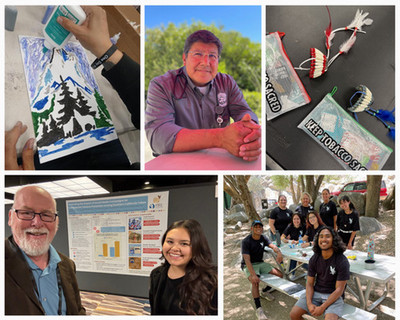
Lessons Learned from the Tobacco Education Prevention Outreach Cessation (TEPOC) Project
This article is based on a Community Research in Action conversation hosted by TRDRP featuring Dr. Daniel Calac and Dr. Roland Moore, who reflected on their long-standing partnership and shared lessons learned from conducting community-partnered participatory research in Tribal communities.
For more than two decades, a partnership between researchers and Tribal communities has demonstrated what community-partnered participatory research looks like when community voices lead the way.
Through collaboration, trust, and shared decision-making, the TRDRP-funded Tobacco Education Prevention Outreach Cessation (TEPOC) team has advanced commercial tobacco prevention efforts while building capacity among future public health leaders.
Leading this work are Dr. Daniel Calac, Chief Medical Officer of the Southern California Tribal Health Center (SCTHC), and Dr. Roland Moore, Senior Research Scientist, at the Pacific Institute for Research and Evaluation (PIRE) California. SCTHC serves a number of federally recognized consortium tribes of the Native American reservations in Southern California. Their partnership, which began 20 years ago, has evolved through a series of projects addressing alcohol, substance use, and commercial tobacco use among young people in Tribal communities.
Letting the community set the agenda
The current project traces its roots to a Scientific Advisory Board meeting where a Tribal leader asked, “What about vaping? What can you do to reduce the vaping epidemic that we see among our youth?” These questions became the catalyst for research focused on addressing multi-level determinants of commercial tobacco use. The project was also informed by community health assessments involving more than 400 community members, which consistently identified commercial tobacco use among the community's top health concerns.
When it comes to community engagement in research, what excites Dr. Calac is the community transformation he has witnessed over time. “The biggest hurdle in many communities is understanding what research is,” he reflected. “Now they’re activated - they know what research is,” so community members are not only familiar with the process, but they are also actively engaged in shaping it.
Trust is the cornerstone
When asked what makes their partnership successful, both Co-Principal Investigators (Co-PIs) emphasized trust, active listening, and showing up. "Being present matters," Dr. Calac explained, as building relationships requires academic partners to spend time in the community, listen carefully, and understand community perspectives before diving into developing interventions.
Dr. Moore emphasized that “Trust is the cornerstone of the whole research enterprise.” This trust is fostered by maintaining regular communication through weekly meetings, frequent community visits, and participation in cultural celebrations and community events. Dr. Calac reiterated that it “makes a tremendous difference to community members and the research team when you have the [academic Co-PI] coming down and being an active partner.”
The project also incorporates multiple layers of community oversight, including a Scientific Advisory Board, a Community Advisory Board (made up of members of the Southern California Tribal Tobacco Coalition), a Tribal Institutional Review Board, and Tribal Council approvals. These structures help ensure that research findings are aligned with community values while respecting traditional tobacco, Tribal sovereignty, and self-determination.
Research that translates into action
The project’s Reward and Reminder Program has become a powerful example of how community-engaged research addressing community norms can generate measurable change. Using young adult volunteers, the project assessed whether retailers on or around Tribal lands request identification before selling commercial tobacco products. Retail clerks who complied with the law were recognized with rewards and acknowledgment on social media, while those who failed to ask for identification were provided education about community expectations and Tribal resolutions supporting youth commercial tobacco prevention. Over time, the percentage of retailers selling commercial tobacco products without checking identification declined by 25%.
The project's impact extends beyond the retail environment. SCTHC’s commercial tobacco cessation referrals have grown dramatically, increasing from just five referrals in year 1 to 141 referrals in year 4. Cessation groups provide culturally grounded sessions featuring such hands-on activities as beadwork and gourd painting alongside discussions about healing and wellness. Staff across multiple departments, including medical, dental, behavioral health, and family services, received culturally tailored cessation training and now integrate referral practices into routine care. These changes demonstrate the importance of multi-level approaches to reach the various spheres of influence that shape commercial tobacco use.
Youth leadership creates lasting impact
One of the most inspiring aspects of this project is the leadership of students from surrounding universities who participated through SCTHC’s research and student development program. These young scholars were not only actively involved in collecting data and designing community outreach efforts but also formulated the Tribal Council resolutions supporting the implementation of the Reward and Reminder program. Dr. Moore highlighted that these approvals from Tribal leaders laid the groundwork for the research project’s successful implementation in the community.
Another standout example of the project’s youth leadership was the creation of an 80-page Tribal Tobacco Youth Advisory Group toolkit. What began as a student-driven idea has become a widely shared resource for Indigenous communities across the U.S. and internationally. The investigators acknowledged that the creativity of these young scholars expanded the project’s original vision far beyond what they initially imagined.
Lessons to carry the work forward
One of the strongest lessons from this project is that successful community-partnered participatory research begins with relationships. Also, creating a framework that maintains scientific rigor while leaving room for community members, students, and partners to shape the direction of the work has been critical to the project’s success. Many of the project's most impactful ideas emerged from the boundless creativity of youth leaders and community members.
The team’s advice to other researchers who are interested in working with Tribal communities is to invest time in building authentic partnerships, respect community priorities and sovereignty, while remaining flexible and open to new ideas. Dr. Calac highlighted that sustainable change includes mentoring future leaders, ensuring that knowledge, experience, and lessons learned are passed on so that efforts to improve the health and well-being of communities can continue across generations.
Acknowledgements
We gratefully acknowledge the many individuals who contributed to this project, including: Dr. Juliet Lee, Chase Kornacki, Joseph Rodriguez, Chrissy Gonzalez, Abigail Andaluz, Lisa Brucks, David Dawson, Bryan Davis, Cy England, Vera Inoue-Terris, Kurt Schweigman, Dr. Mark Myers, Dr. Cynthia Begay, Orvin Hanson, Angelina Renteria, Heidi Hitt, the Reward and Reminder volunteers, Tribal leaders, the members of the Scientific Advisory Board, Community Advisory Board, Youth Advisory Council, SCTHC staff, and PIRE California staff.
Funding: This research was supported by TRDRP grants T30IR0933 and T32CF5371(Co-PIs Calac and Moore).
Written by: Joanne D’Silva, PhD, MPH, TRDRP Program Officer
Picture on top of the page:
Top left (image 1): Sacred Breath Circle artwork (photo by Christina Gonzales).
Top center (image 2): Daniel J. Calac, MD, MPH (photo by Roland Moore).
Top right (image 3): Sacred Breath Circle artwork and quit support kits (photo by Christina Gonzales).
Bottom left (image 4): Roland Moore, PhD and Chase Kornacki, MPH at the Society for Research on Nicotine and Tobacco conference (photo by Lisa Brucks).
Bottom right (image 5): Tribal Youth Tobacco Summit participants (photo by Roland Moore).